

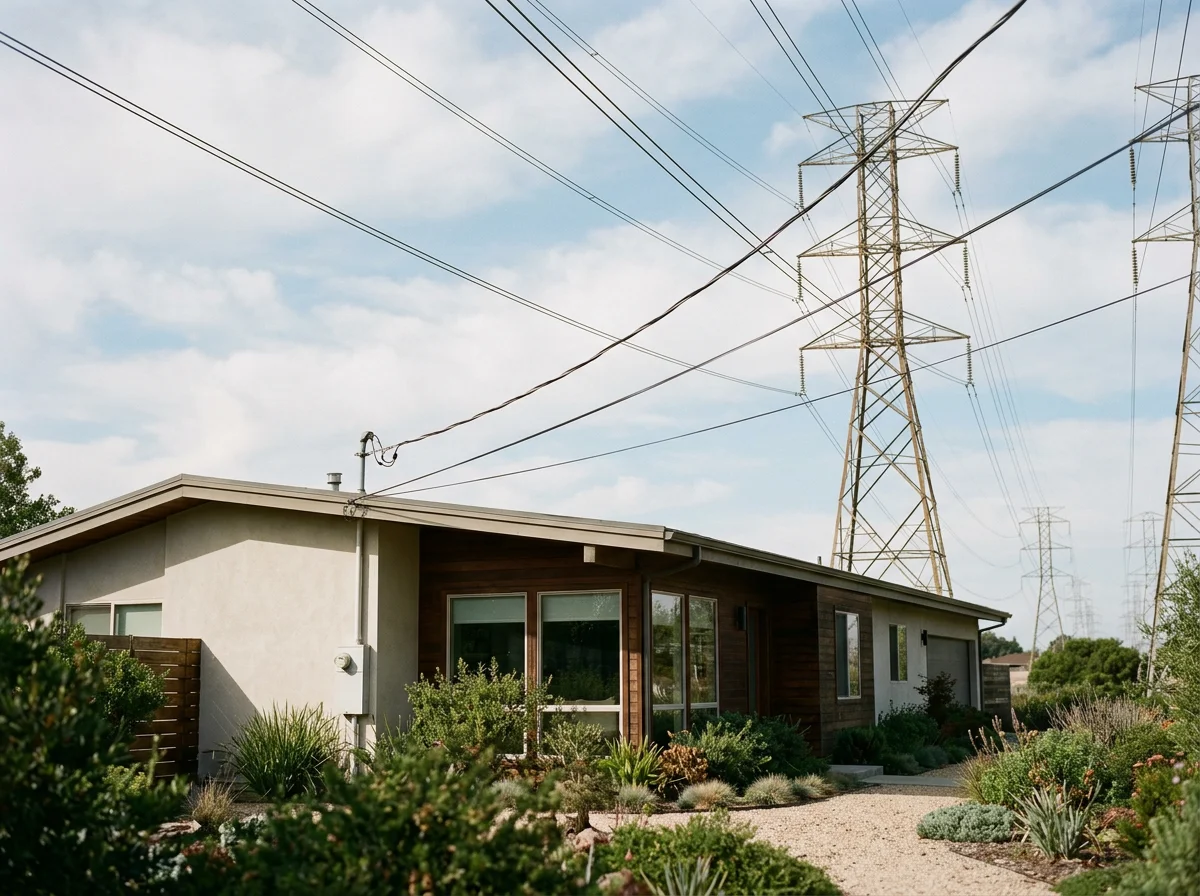
Power lines cross suburbs all over Sydney, and plenty of homes sit within sight of one. That raises a fair question, and a fair answer has more nuance in it than a simple yes or no. The concern is not the electricity supply in your walls, and it is not the risk of a wire coming down. It is the low-frequency magnetic field that surrounds any conductor carrying current, and whether living inside that field day after day has any measurable effect on health.
Getting to a useful answer means knowing what kind of line you are looking at, understanding why distance matters more than appearances, and being honest about where the health research currently sits.
What counts as an overhead power line?
Power lines are a network of wires and insulators. They connect and transport high-voltage electricity from generators to the places that use it. An overhead power line is the structure used in electric power transmission and distribution to move electrical energy across long distances.
Not every line is the same, and the distinction matters when you are assessing a property. A wire on a timber pole at the front of a house is a very different asset from a steel tower carrying a transmission span across a valley.
Transmission and distribution lines do different jobs
Transmission lines take electricity over long distances, from power stations to transformer stations. They carry high voltage, up to 800,000 Volts, to carry massive currents.
The distribution wires take lower voltage electricity (240V) from the substation to the households.
You can easily see the difference by the size and number of ceramic insulators, that hold the wires to the pole structure.
A generic opinion about "power lines" tells you very little about a specific address. Voltage, the current actually flowing, the height of the conductors and their arrangement all change the field that reaches a bedroom window. That is why the only meaningful answer is a measured one.
The health question is really about magnetic fields
Any live wire produces both electric and magnetic fields. Electric fields are relatively easy to interrupt, because building materials, trees and earth reduce them substantially. Magnetic fields behave differently. They pass through most ordinary construction, so a brick wall does not offer much protection between a conductor and a bed.
What changes a magnetic field is current, distance and the configuration of the conductors. Current is the variable people underestimate. A line may carry more electricity at some times than others, which means the field at a given point is not a single fixed number. A measurement taken on a quiet Sunday morning is a snapshot, not the whole story.
Distance is the biggest lever
Field strength falls away quickly as you move further from a conductor. This single fact shapes most practical advice about living near power lines, and it explains why two houses on the same street can have quite different exposures. One may back directly onto an easement, while another sits several blocks away and still shares the same postcode and the same impression of living near the lines.
Distance is also the thing most people cannot change. You can move a bed, but you cannot move a tower. That is why an assessment early in a purchase decision is worth far more than one carried out after settlement.
Childhood leukaemia and the evidence
Much of the public concern about power lines traces back to research into childhood leukaemia in homes close to high-voltage lines. That research is a genuine part of the story and it deserves to be treated seriously rather than waved away.
It also needs to be read carefully. Studies of this kind are epidemiological, which means they look for statistical patterns in populations. On their own they cannot establish that a field caused an illness. Findings have not been consistent from one study to the next, and no mechanism has been agreed that would explain how a weak magnetic field could initiate disease.
What follows from that is a practical rule. Any specific risk figure you see quoted, in a blog, a forum thread or a conversation with a neighbour, should be traced back to its original study and checked against current guidance from official health bodies. Be wary of confidence in both directions: claims that power lines are proven to cause cancer, and claims that there is nothing here worth measuring at all. Neither position matches the state of the evidence.
Building Biologists apply the precautionary principle, as their measuring standard is founded on biological impact, not on thermal damage to tissue, like government standards. To explain this fundamental difference. -
High magnetic fields can be so energy dense that they heat up tissue, like a microwave would. This is used in conduction stoves. Once a chunk of meat is not getting hot in a magnetic field, the field strength is reduced and declared safe for humans.
To the contrary, biological effects like cancer, DNA damage, metabolic change, - are occurring at much lower levels, which forms the basis for the Buildingbiological Standard.
What a building biologist actually assesses
An electro-pollution assessment is not a matter of guessing from a photograph or a distance estimate. A competent assessment typically covers:
Room-by-room measurements taken where people sleep, sit and work, not just at the front fence
Internal wiring and earthing issues, since faults and net current can create magnetic fields inside a home that have nothing to do with the street
Switchboards, meter boxes and major appliances, which are localised sources in their own right
Distance, height and configuration of nearby lines, cross-checked against the network operator's maps
Practical recommendations, like furniture placement, wiring adjustments, or shielding products.
Timing matters as well. Because current varies, a single reading can be misleading. A useful assessment builds a picture across different conditions and separates what an occupant can control, such as where the bed sits, from what they cannot. Shielding has its place in some situations, but it is rarely the first answer.
Measurement comes first, then a plan.
Checking the power lines near an Australian property
Australia has good public tools for this. The Look Up and Live map lets you locate overhead power lines at a site and combines several important safety features in one place. It was built for people planning work near lines, and it is equally useful for a homeowner or buyer who wants to know what runs across the back fence, at what voltage, and who owns it.
Electricity distributors also hold information about their networks. Maps showing the general location of the electricity network are available on request from the operator for individuals and companies. For an exact voltage on a specific span, contact the relevant distributor or the technical regulator in your state, since published guides to identifying powerlines are general in nature rather than property-specific.
If you are buying, building or already living near power lines
Pre-purchase inspection is the cheapest way to deal with this. Book an assessment before you are emotionally committed to a property, and have the measurements taken in the rooms that matter rather than relying on a rough distance estimate from a listing photo.
For a new build, the layout can be designed around the findings. Bedrooms can be positioned away from the nearest span, the switchboard and meter box can be placed thoughtfully, and wiring can be installed in a way that reduces the fields created inside the home rather than adding to them.
If you already live near power lines and are not planning to move, the work is about reducing exposure where it counts most, which for most people means the bed, and about correcting any internal wiring issues that are adding to the load. Sometimes the most significant source in a house is not the line outside at all.
Frequently Asked Questions
Is living near power lines dangerous?
The honest answer is that it depends on the field strengths involved, and that the health evidence is not settled. Concern about childhood leukaemia is legitimate and still needs further research to find the causation. Measuring the rooms you actually use gives you something concrete to act on rather than an abstract worry.
How close is too close to power lines?
There is no universal distance, because voltage, current load and conductor layout all vary. Two properties the same distance from a line can measure quite differently. The reliable approach is measurement in the rooms you sleep and work in, followed by advice on what those readings mean for your household.
Do power lines cause childhood leukaemia and other cancers?
Research has examined this for decades without reaching a settled answer. Findings have not been consistent between studies, and no agreed mechanism explains how a weak magnetic field could cause disease. That is a reason to measure and to check, not a reason to panic or to dismiss the question.
Can trees or walls block magnetic fields from power lines?
Not much. Trees, walls and earth reduce electric fields far more effectively than magnetic fields, which pass through most ordinary building materials. That is why distance from the conductor matters more than what stands between the house and the line, and why planting a screen does not solve the problem.
What does a building biologist measure near power lines?
A building biologist measures magnetic fields room by room at the places people actually spend time, then checks internal wiring, earthing, switchboards and appliances, because these can contribute as much as a line in the street. The output is a remediation roadmap, not just a set of numbers.
Are there other sources of magnetic fields?
Any wire that carries a current (i.e. electricity travels through it) creates a magnetic field. The larger the current (heating, cooling, pool pump) - the more intense the field.
Given that field intensity diminishes rapidly with distance, concerns from the visible impact of power poles may be less justified than the proximity of wiring near the fuse box and beneath the bed. These installations generate fields in close proximity, resulting in comparatively higher intensity exposure.
Can I measure the fields myself?
With the right instruments, it is possible to measure yourself, as long as you know how to interpret the results. - See a previous blog post about measuring electromagnetic fields.