
A musty smell that never quite leaves. A dark patch on the cornice that comes back a fortnight after you scrub it. A family member whose cough clears up whenever they stay somewhere else. These are the usual reasons Sydney homeowners pick up the phone and ask for a mould inspection, and they are good reasons. Mould that keeps returning is usually mould that was never properly diagnosed in the first place.
A proper inspection is not a bloke with a torch and an opinion. It is a sequence of measurements, samples and cross-checks that ends in a written report you can act on, hand to a remediator, or use in a conversation with a builder or strata manager. This guide walks through what that sequence looks like, what laboratory testing actually adds, why species identification matters, and what a sensible next step looks like once the results land.
Why Sydney properties hide so much mould
Sydney has a reputation problem. One local mould specialist reports that Sydney ranks as the most mould-affected capital city in Australia, with a mouldiness score of 92.48 out of 100. The same source notes the city has recorded close to 120 per cent more mould-related tasks than the national average, and that residents in the Eastern Suburbs face rates roughly 547 per cent above the norm.
Whatever the precise figures, the pattern matches what inspectors see on the ground. Sydney's humidity, its older housing stock and its fondness for sub-floor spaces with limited ventilation all create the conditions mould needs. Add a bathroom exhaust fan that ducts into the roof cavity, a slow leaking shower recess, or a garden bed built up above the damp course, and you have a moisture reservoir feeding growth that never appears on the surface you clean.
That hidden quality is the whole problem. Mould growing behind plasterboard, under timber flooring or inside a wall cavity releases spores into the indoor air long before a stain shows up. This is exactly why specialist inspections lean on tools such as thermal imaging, which can reveal cool, damp patches behind a painted wall that looks perfectly normal to the eye.
What a mould inspection in Sydney covers
Reputable inspection services describe a similar structure. Surface and air sampling confirm whether there is a problem, how far it reaches, and what it will take to resolve, all documented in writing. The moisture side of the job is treated as seriously as the mould side, because sub-floor ventilation, rising damp treatment and similar controls are what stop the growth returning.
Some firms also produce mould causation reports, which trace the growth back to its source rather than simply listing what was found. For newer properties, a dedicated new home mould inspection is used to uncover moisture issues and assess builder liability. Both approaches reflect the same principle: mould is a symptom, and the report is only useful if it identifies what the symptom is pointing at.
The inspection process, step by step
History and interview. Where do you smell it, when did it start, what has been cleaned, and has anything been renovated or re-roofed recently. This shapes where the inspector looks.
Walk-through and moisture mapping. Readings are taken across walls, floors and ceilings to find elevated moisture that the eye cannot see.
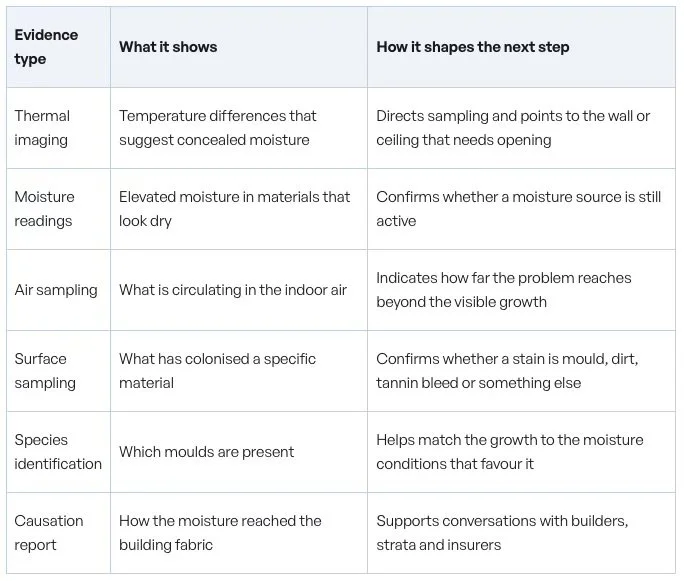
Thermal imaging. An infrared camera shows temperature differences that often correspond to concealed damp, which helps narrow down where to sample.
Air sampling. A measured volume of indoor air is drawn through a sampler to capture airborne spores, giving a picture of what is circulating in the rooms you actually occupy.
Surface sampling. Tape lifts or swabs are taken from visible growth or from suspect materials, recording exactly where each sample came from.
Laboratory analysis. Samples are sent to a laboratory for microscopy and, where required, culture, with the results returned as a written report.
What laboratory testing actually adds
Laboratory analysis turns guesswork into data. An air sample tells you what is airborne in a given room at the time of sampling. A surface sample tells you what has colonised a particular material. Put together, they distinguish between a localised patch on a bathroom ceiling and a broader problem where spores are being distributed through the home by air movement or ducted heating.
The written report is where that data becomes useful. A credible report identifies each sample location, records the result for that location and states clearly what it indicates. Numbers without context are not much help. A spore count with no accompanying moisture readings, no thermal images and no notes on building construction is a data point, not a diagnosis.
Species identification and why the name on the report matters
Mould identification goes down to genus and, where the laboratory is able to, species level. That detail is not academic. Different moulds have different moisture requirements and different preferred materials, so the species present often points toward the type of moisture problem behind the wall.
Species identification also helps separate an active problem from an old one. Growth that dried out months ago may still leave dead spores and staining behind, and knowing what you are looking at helps avoid unnecessary demolition. Conversely, a species list that keeps appearing across multiple rooms, together with elevated moisture readings in the same areas, suggests a continuing source rather than an old spill.
The practical value sits in the combination. A species name on its own tells you what grew. A species name attached to a thermal image, a moisture reading and a floor plan tells you where the water is coming from and what has to change.
Reading the evidence together
What comes next after the inspection
The report should end with a plan, not just a verdict. In most Sydney properties that plan has two tracks running in parallel: removing the growth and correcting the moisture.
On the moisture side, the usual suspects are sub-floor ventilation, rising damp treatment, leaking plumbing, failed waterproofing and roof or flashing defects. On the mould side, porous materials that have been colonised often need to be removed rather than wiped, because dead spores and fragments remain in the material even after treatment. Fogging treatments are sometimes used, but they make little sense until the moisture source is addressed.
Verification matters as much as remediation. A sensible sequence is to fix the moisture, carry out the removal work, allow the structure to dry, and then re-test to confirm the problem has actually resolved. Skipping that final step is how people end up repeating the whole exercise a year later.
Choosing a mould inspector in Sydney
Look for someone who combines building knowledge with testing credentials. The field includes technicians certified in advanced mould and moisture testing, and that combination of qualifications is a reasonable benchmark. Ask what the report includes, whether samples go to an independent laboratory, whether thermal imaging is part of the visit, and whether moisture readings are documented alongside the spore results.
Pricing varies with the size of the property, the number of samples and the depth of reporting, so request a written quote that itemises laboratory fees separately. A cheap visual inspection with no sampling will not tell you whether the problem is contained or spreading.
Buildingbiology Services is a Sydney-based buildingbiology consultancy led by certified building biologist Joachim Herrmann. Its mould inspections include laboratory sampling, species identification and a remediation roadmap, and the same assessments can cover indoor air quality, electro-pollution and soil testing for clients who want the whole picture of their home's health.
When it is worth booking an inspection
The same patch of mould returns within weeks of cleaning.
A musty odour persists in a room with no visible growth.
Occupants report symptoms that ease when they leave the building.
You are buying a property and want a health check before exchange.
A renovation or new build has produced condensation, leaks or damp patches.
You suspect a concealed leak but cannot find it.
Frequently Asked Questions
How much does a mould inspection cost in Sydney?
Costs are not published as a single figure because they depend on property size, how many samples are taken and whether laboratory analysis is included. Ask for a written quote that separates the inspection fee from laboratory charges. Compare what each quote actually covers rather than the headline number, since a visual-only visit and a full sampling inspection are very different services.
Can mould be found without any visible growth?
Yes. Thermal imaging can reveal cool, damp areas behind painted surfaces, moisture readings can flag elevated content in materials that look dry, and air sampling can show what is circulating in a room. A musty odour with no visible growth is one of the most common reasons people book an inspection in the first place.
Should I clean the mould before an inspection?
It is better to leave visible growth in place until the inspector has seen and sampled it. Cleaning removes the evidence and can spread spores across a wider area. If the growth is extensive or in a bedroom, keep the door closed and ventilate the rest of the home instead of scrubbing it yourself beforehand.
What is the difference between an inspection and mould testing?
An inspection is the broader assessment: the walk-through, moisture mapping, thermal imaging and sample collection. Mould testing refers specifically to the laboratory analysis of the samples gathered during that inspection. The most useful outcome combines both, with laboratory results interpreted alongside the moisture and building findings in a single written report.
If a mould problem keeps coming back, the fastest route forward is usually to stop cleaning and start measuring. A documented inspection gives you the evidence to fix the cause properly, whether that means a sub-floor ventilation upgrade, a waterproofing repair or a conversation with the builder who handed over the keys.
Mould Inspection Sydney: Lab Testing and Species ID