

How to measure and reduce EMF exposure in your home: A practical step-by-step guide
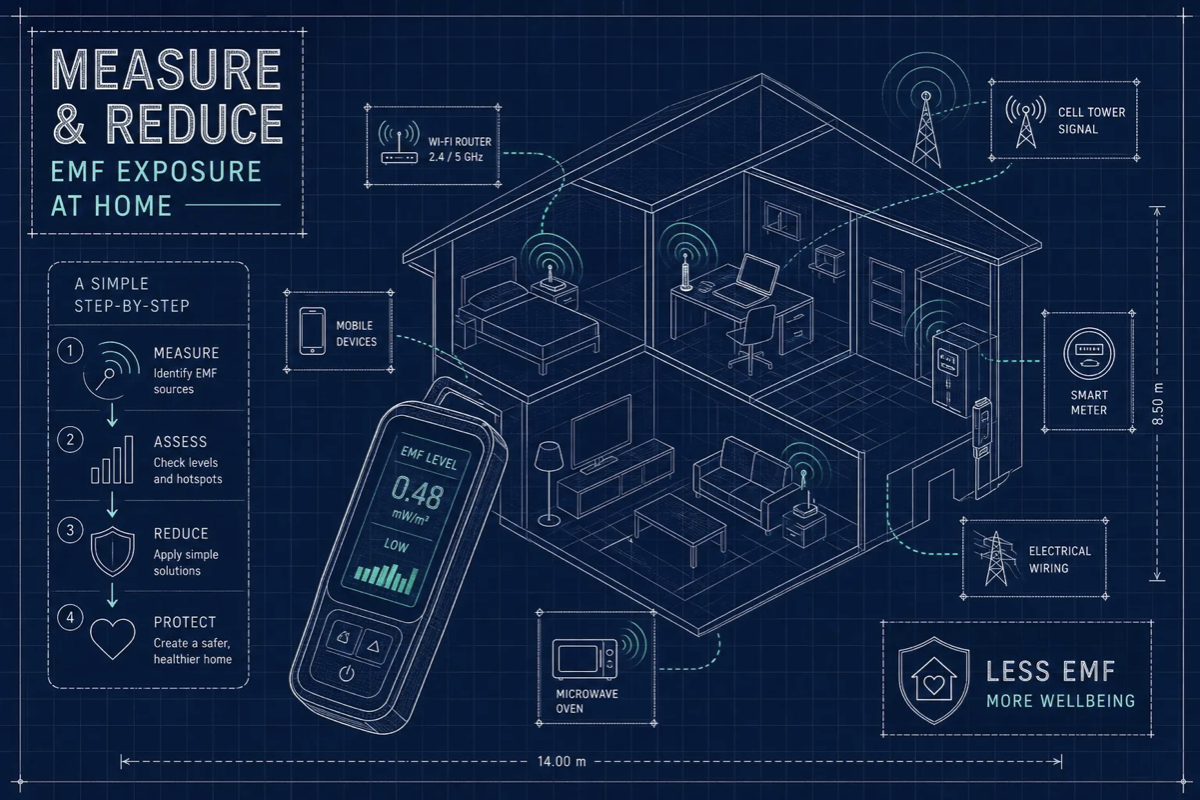
Most people thinking about EMF protection for home fall into one of two camps: they either dismiss it entirely and do nothing, or they start panic-buying stickers, plug-in harmonisers, and expensive "whole-home systems", many of which lack independent, standardised third-party testing. If you've recently had a smart meter installed, you're running two or three Wi-Fi networks across different floors, and your router sits a metre and a half from your pillow, the question of what to actually do is a reasonable one. This guide gives you a structured, measurement-first approach to reducing electromagnetic exposure indoors, without the guesswork or the wasted money. Building Biology Services Australia has been helping Sydney and NSW residents navigate exactly this question since 1993, using calibrated instruments and building biology principles instead of product marketing.
The goal here is practical: identify your actual sources, get a reliable picture of levels, and prioritise the steps that deliver real results. You don't need to spend thousands to make meaningful improvements, but you do need to understand what you're dealing with before you act. This guide walks you through source identification, measurement, behavioural changes, and shielding options in that order, so every decision is grounded in evidence rather than anxiety.
Where household EMF actually comes from
Low-frequency fields: wiring, appliances, and power circuits
Extremely low frequency (ELF) fields in Australian homes come primarily from household wiring, the switchboard, and the appliances in daily use. ARPANSA data puts typical magnetic fields away from appliances at around 0.1 to 2 mG for most homes, but proximity to the source matters far more than the source simply existing in the building. Common appliances generate significantly higher readings right at the device: hair dryers sit between 10 and 70 mG, electric blankets between 5 and 30 mG, and personal computers between 2 and 20 mG. The critical point is that ELF fields drop sharply with distance, so moving even half a metre further away from an appliance changes your exposure substantially. Earth-return currents travelling through plumbing can also contribute to the ELF picture, particularly in older homes where wiring predates modern earthing and neutral-return separation standards.
Radiofrequency sources: Wi-Fi, phones, smart meters, and solar inverters
The radiofrequency (RF) layer in a modern Australian home is largely invisible but persistent. Routers transmit continuously, smartphones pulse when sending or receiving data, smart meters transmit at regular intervals throughout the day, and solar inverter electronics generate both ELF and RF components. ARPANSA identifies all of these as recognised indoor RF sources. What makes routers and smart meters particularly worth attention, from a low-EMF house perspective, is that they operate 24 hours a day instead of intermittently like a hair dryer. A hair dryer runs for three minutes; a router runs all night while you sleep 1.5 metres away. The cumulative daily exposure from always-on sources is where the behavioural changes outlined below make the biggest difference.
EMF protection for home: how to measure levels before you spend anything
Choosing the right meter type for the job
There are two distinct measurement categories a homeowner needs to cover: a gaussmeter or ELF meter for low-frequency magnetic fields, and a broadband RF meter or spectrum analyser for radiofrequency. A single cheap "all-in-one" meter often misses significant frequency bands entirely, giving readings that are misleading in either direction. Calibrated instruments from Gigahertz Solutions, available from specialist suppliers including Building Biology Services Australia, give results comparable to what a professional consultant uses in the field. Uncalibrated consumer gadgets, by contrast, can read high or low by a wide margin, which means decisions made on those readings are unreliable. If you're going to invest in a meter, invest in a calibrated one.
What readings actually mean: interpreting results against Australian guidelines
ARPANSA's RF exposure limits for the general public sit well above typical residential levels, so a detectable reading is not the same as a reading that warrants action. Context is everything. Building biology consultants work to precautionary exposure guidelines, such as the SBM-2008 building biology evaluation guidelines, that set tighter thresholds than the regulatory minimum. These benchmarks are what health-conscious homeowners often prefer to work towards, particularly for sleeping environments. For reducing EMR exposure at home, the approach is to start by mapping your highest-exposure zones (usually the bedroom and home office), note the readings at positions where you spend the most time, and then evaluate whether those readings fall within the regulatory standard, the tighter building biology benchmarks, or well above both. That context shapes which interventions are worth the effort.
Behavioural changes that cut exposure immediately
Practical EMF protection for home, distance, duration, and device habits
The inverse square law is the most powerful tool available and it costs nothing. For far-field RF sources, doubling your distance from a source reduces field strength by roughly 75%; for ELF magnetic fields around wiring and appliances, the rate of fall-off varies by source type and is best confirmed by measurement rather than formula. Applied to daily life, these principles mean charging your phone on the opposite side of the bedroom instead of on the bedside table, relocating the router out of the bedroom or home office where you spend concentrated time, keeping a laptop on a desk rather than directly on your lap, and replacing cordless DECT phones with corded models. Switching devices off at the wall when not in use eliminates the field entirely. None of these are extreme measures; they are straightforward adjustments with measurable impact.
Router and smart device settings that reduce RF output
Beyond physical distance, there's a software layer worth addressing. Most modern routers support scheduling via firmware or a smart plug, which allows you to cut power overnight during sleeping hours without affecting the next morning's use. Disabling the 5 GHz band on devices that don't need it, turning off Bluetooth when unused, and putting phones into flight mode during sleep are all steps that directly reduce RF load in the spaces where you spend the most concentrated time. These changes take under ten minutes to implement and, combined with the distance habits above, shift daily exposure significantly without reaching for your credit card.
Wiring upgrades and shielding products worth considering
Once you've made the no-cost behavioural changes, your measurement results will tell you whether further infrastructure investment is warranted. Hardware and wiring solutions are the next tier, and they are genuinely effective when targeted at the sources your readings actually identify.
Hardwiring with Ethernet: the most effective RF reduction step for stationary devices
Replacing Wi-Fi with Ethernet for fixed devices eliminates a continuous RF source as opposed to simply managing it. Desktop computers, smart TVs, gaming consoles, and home office setups are all good candidates because they don't move. In Sydney and NSW homes in 2026, professional Ethernet installation runs approximately $150 to $300 per drop for a licensed data cabler, with a whole-home retrofit of four to six drops typically landing between $600 and $1,800 depending on wall access and run complexity. In a new build or renovation, those costs drop sharply because cabling is installed before walls are closed. For devices that must remain wireless, hardwiring everything else at least reduces the total RF load in the environment, a meaningful improvement in most households.
Shielding paint, fabrics, and bed canopies: what the evidence actually shows
RF shielding for residential use is the next tier of intervention, but expectations need to be grounded in what independent tests actually show. YShield HSF54, one of the more consistently documented products on the market, shows approximately 46 dB attenuation per single coat at 1 GHz and around 53 dB for a double coat at standard application rates, based on testing to IEEE Std 299-2006. Those are strong numbers on a flat sealed surface in controlled lab conditions. Real-world performance depends heavily on application consistency, grounding, and whether windows, doors, and penetrations are also addressed. Even a gap of a few centimetres can significantly degrade the result in an enclosed space.
EMF shielding fabric and Faraday canopy products designed for sleeping areas can provide measurable attenuation at RF frequencies, but most independently available data comes from manufacturer test sheets rather than third-party published lab reports. Before purchasing any shielding product, look for three things: the frequency range tested, the attenuation value in dB, and the testing standard used. If those aren't specified, the claim can't be evaluated. One category to avoid: "harmoniser" stickers and plug-in adapters have no credible independent measurement data supporting their stated mechanisms, the research literature finds no standardised, reproducible lab evidence for such products. Save that budget for something with a dB figure behind it.
Building new or renovating? Design it low-EMF from the start
Wiring layout and material decisions that prevent problems later
A new build is the most cost-effective point to address EMF because design decisions are made before walls are closed. Key considerations include using shielded cabling for all fixed data runs, locating the main switchboard on an external wall away from bedrooms, keeping high-draw wiring runs out of bedroom walls, and installing conduit throughout so cabling can be upgraded without demolition. Specifying a whole-home Ethernet backbone during construction makes Wi-Fi optional instead of essential, a fundamentally different starting position than retrofitting later. Building biology principles address all of these decisions as standard practice when a certified consultant is involved at the design stage.
Creating low-EMF zones for sleeping and resting areas
The bedroom is the highest-priority space because people spend seven to nine hours there, making it the single largest contributor to daily exposure. Practical design steps include specifying no wiring runs in the wall directly behind the bed head, positioning the electrical switchboard as far from sleeping areas as possible, pre-wiring a circuit kill switch that cuts power to the bedroom at night, and keeping wireless smart home devices out of sleeping zones entirely. Architects and builders working with a certified building biology consultant at the design stage can incorporate these requirements without additional structural cost, because the decisions happen before concrete and plasterboard lock everything in.
When a professional EMF assessment is worth it
What a calibrated survey covers and why DIY has limits
A professional EMF assessment uses calibrated laboratory-grade instruments that cover a broad frequency range and detect field types that consumer meters miss entirely. A thorough residential survey maps ELF magnetic fields from wiring and appliances alongside the full RF spectrum from every source inside and outside the building envelope. This approach identifies unexpected contributors: faulty wiring creating net current on plumbing, neighbouring Wi-Fi networks penetrating through walls, or a solar inverter generating elevated fields in an adjacent living space. The consultant then prioritises recommendations by field strength, source type, and occupant exposure time, rather than applying a generic checklist. That prioritisation is what makes professional assessment genuinely useful rather than merely confirmatory.
How Building Biology Services Australia can help
Building Biology Services Australia, led by certified building biology consultant Joachim Herrmann, has provided professional EMF and indoor environment assessments across Sydney and NSW since 1993. Surveys use calibrated Gigahertz Solutions instruments for both ELF and RF measurement, covering the frequency ranges most relevant to residential environments. For homeowners who want to act on assessment findings, BBSA also supplies quality-verified shielding products including YShield shielding paint and fabrics, so measurement and solution come from the same verified source. For those building new homes or seeking formal recognition of a healthy indoor environment, the Healthy House Australia certification programme provides an independent benchmark confirming that a building meets defined health and safety standards. Whether the goal is diagnosing an unexplained symptom cluster, verifying a shielding retrofit, or guiding a new build from the ground up, get in touch with the BBSA team for a professional survey grounded in measurement rather than assumption.
EMF protection for home: start with measurement, then act on what you find
The layered approach works best in sequence: identify your sources, measure with a reliable instrument, apply the no-cost behavioural changes first, then evaluate wiring and shielding options based on what the measurements actually show. Effective EMF protection for home does not require spending thousands on unproven products. Most of the impactful steps involve changing how and where devices are used, and those changes cost nothing. For situations where sources are unclear, exposures are elevated, or a new build needs professional input from the outset, a building biology assessment from Building Biology Services Australia gives you the clarity that product purchases alone cannot provide. If you're in Sydney or NSW and want accurate measurements before committing to any intervention, contact the BBSA team for a professional survey that tells you exactly where you stand.
Frequently asked questions about EMF protection for home
What is EMF protection for home?
EMF protection for home refers to the practical steps taken to measure, reduce, and manage electromagnetic field exposure within a residential environment. This includes behavioural changes (such as distance and device habits), infrastructure upgrades (such as Ethernet hardwiring), and targeted shielding measures (such as RF-rated paint or bed canopies), all prioritised based on calibrated measurements rather than guesswork.
What are the main sources of EMF in an Australian home?
The primary sources are household wiring and appliances (which generate ELF magnetic fields) and wireless devices including routers, smartphones, smart meters, and solar inverters (which generate radiofrequency fields). Always-on devices such as routers and smart meters are worth particular attention because they operate continuously, including during sleeping hours.
Do I need a professional EMF assessment, or can I measure myself?
Both approaches have value, but they serve different purposes. A calibrated consumer meter from a reputable supplier such as Gigahertz Solutions can help you identify obvious sources and track the impact of behavioural changes. A professional assessment using laboratory-grade instruments covers a broader frequency range, identifies unexpected contributors (such as net currents on plumbing or external RF sources), and delivers prioritised recommendations based on actual field readings rather than product-category assumptions.
Do EMF harmoniser stickers and plug-in devices work?
No credible independent measurement data supports the stated mechanisms of harmoniser stickers or plug-in adapters. There is no standardised, reproducible laboratory evidence for these products. Shielding products worth considering are those with a verified attenuation figure in dB, a stated frequency range, and a recognised testing standard, not a passive sticker with no measurable output.
How do I know if my EMF levels are a concern?
ARPANSA sets radiofrequency exposure limits for the general public that sit well above typical residential levels. A detectable reading is not automatically a concern, context matters. Building biology consultants apply precautionary guidelines such as the SBM-2008 evaluation benchmarks, which set tighter thresholds than the regulatory minimum. Comparing your measured results against both standards gives you a clear picture of where action is warranted and where it isn't.