

How to recognise and resolve sick building disease in your home
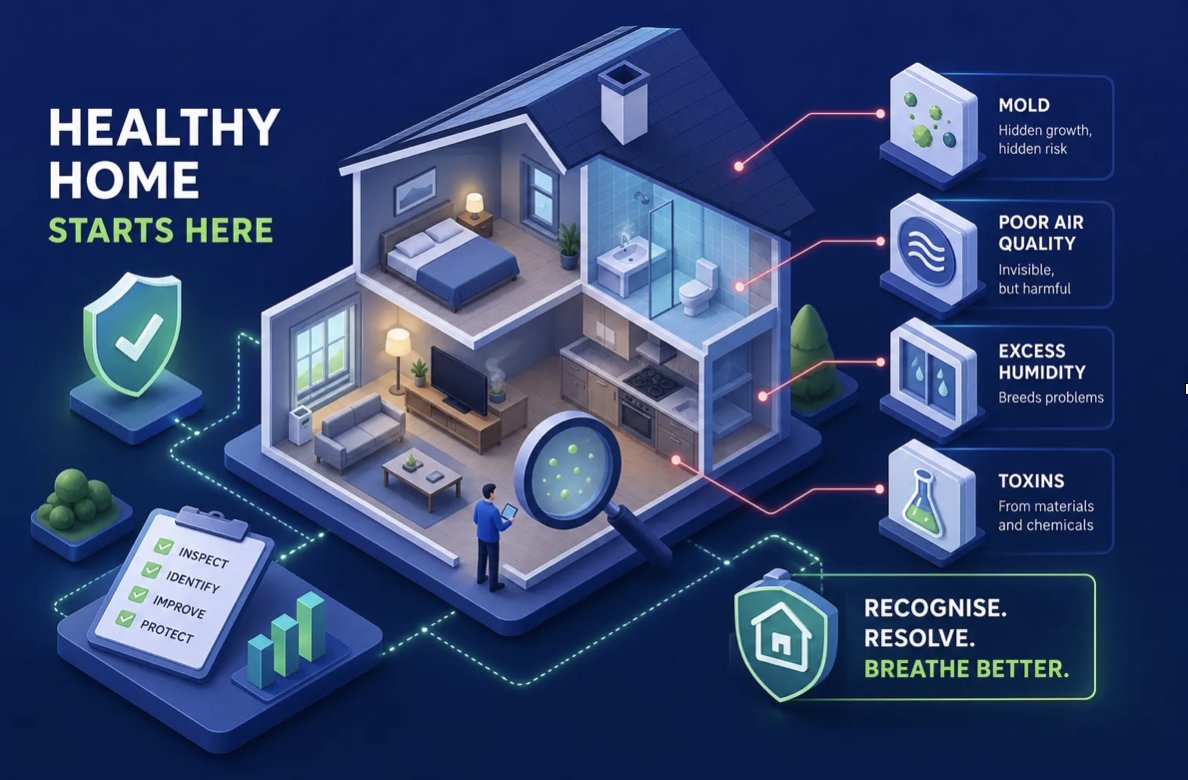
a sick home
Most people who feel chronically unwell at home blame themselves first. The fatigue must be stress. The headaches are probably dehydration, or too much screen time, or getting older. The persistent cough is just the season changing. It rarely occurs to anyone to consider sick building disease, a problem with the indoor environment itself, when they've been sitting in the same building for eight, ten, twelve hours a day.
Sick building disease, more formally known as sick building syndrome (SBS), is a well-documented phenomenon recognised by the World Health Organisation and studied in peer-reviewed literature. It is commonly reported in workplace studies and increasingly identified in residential assessments across Australia. It isn't fringe science. It's assessed through a structured process of environmental investigation, and Building Biology Services Australia has been doing exactly that kind of assessment for many years, helping residents and property owners identify the invisible hazards that ordinary clinical tests never find.
By the end of this article, you'll know what the symptoms look like, what causes them, how to perform a basic risk check yourself, and when to bring in professional help.
What sick building disease actually is
SBS versus building-related illness: a distinction worth knowing
Sick building disease is the informal name for sick building syndrome, a recognised pattern of nonspecific symptoms that occur inside a specific building and resolve once a person leaves. The symptoms are real and measurable in how they affect daily life, but clinical tests return normal results and no single identifiable condition explains them. That's what makes SBS a diagnosis of exclusion: the building, not the body, is where the cause lies.
Building-related illness (BRI) is different and worth understanding separately. BRI refers to a diagnosable condition, such as hypersensitivity pneumonitis or Legionnaires' disease, that can be directly traced to a specific building exposure. If a clinician can point to a confirmed pathogen or allergen and match it to a diagnosable disease, it's BRI. If the symptoms are real but the tests show nothing and they clear up when you leave the building, that's SBS. The distinction matters because it shapes how you investigate and what you do about it.
Why Australian homes are increasingly affected
Modern construction has created tighter, more energy-efficient building envelopes. That's good for power bills. It's less good for the air you breathe inside. When synthetic building materials, adhesives, treated timbers, and engineered flooring are sealed inside a poorly ventilated space, chemical concentrations build up in ways that older, draughtier homes rarely experienced. Denser urban environments and the proliferation of wireless devices have also introduced new considerations for indoor environmental quality that previous generations didn't contend with.
There is no single legislated national indoor air quality standard for residential buildings in Australia. Workplace settings have more coverage, through Safe Work Australia's WHS framework and standards like AS/NZS 1668 and AS/NZS 3666, which set requirements for ventilation and HVAC maintenance. But for homeowners, the regulatory gap is real: the responsibility for monitoring and managing your indoor environment largely falls on you. Most people don't know that, which is why so many cases of building-related illness go unidentified for years.
Symptoms of sick building disease and how to recognise them
The tell-tale pattern most people overlook
The core symptoms of sick building syndrome are not dramatic. They typically include eye, nose, and throat irritation, persistent headaches, fatigue and difficulty concentrating, dry or itchy skin, coughing or wheezing, and occasional dizziness or nausea. These are precisely the kind of complaints that get attributed to stress, allergies, or ageing, and then quietly tolerated for months or years without anyone asking the right questions.
The diagnostic clue is not in any single symptom. It's in the pattern. Symptoms begin during time in the building, often within a few hours, and improve after leaving, sometimes within minutes. That consistency, day after day, in the same space, is what separates building-related symptoms from a general health complaint. When the pattern repeats reliably, it stops being a coincidence.
When the pattern becomes a signal worth investigating
Occupant clustering is another strong indicator. When multiple people in the same household or workplace report similar complaints without a shared identifiable illness, the building itself becomes the prime suspect. This is one of the key diagnostic signals used in both clinical and environmental assessments. A single person with vague symptoms is easy to overlook; three people in the same building all reporting headaches and fatigue by midday is a pattern that demands investigation.
A simple self-assessment question is often the clearest first step: do you feel noticeably better on weekends, on holidays, or whenever you spend extended time somewhere else? That single question, answered honestly, is frequently what prompts people to recognise that their indoor environment, not their health, is the issue. If the answer is yes, the building deserves scrutiny.
The hidden causes making your home work against you
Mould, moisture and what's happening behind your walls
Mould is one of the most consistently documented contributors to building-related illness. It doesn't need to be visible to cause harm. Fungal spores circulate through HVAC systems and settle into soft furnishings, carpet, and wall cavities, where spore inhalation and allergic inflammatory responses are well established in the literature. Moisture intrusion from leaky roofs, poor subfloor drainage, condensation on cold surfaces, and inadequate bathroom ventilation creates exactly the conditions mould needs to thrive. In Australian homes, this is particularly common after flooding events or in poorly ventilated bathrooms and under-floor spaces where moisture accumulates undetected.
The absence of visible mould is not reassurance. A persistent musty odour, even in a room that looks perfectly clean, is a reliable early indicator of concealed fungal growth. Surface testing behind walls, under flooring, and in ceiling cavities is often the only way to confirm what's actually there.
VOCs, poor ventilation and electro-pollution: what the evidence says
Volatile organic compounds off-gas from paints, adhesives, synthetic flooring, engineered timber products, furniture made from particleboard or MDF, and everyday cleaning products. New paint and composite wood products can cause the highest short-term spikes, while pressed-wood furniture and cabinetry drive longer-term formaldehyde exposure, sometimes for years after installation. Australian health guidance references a formaldehyde indoor threshold of 0.1 mg/m³, but most homeowners have no way of knowing whether their indoor levels are above or below that figure without testing.
Poor ventilation is the single most consistent environmental factor linked to sick building syndrome across the research literature. When fresh air exchange is insufficient, CO₂ rises and chemical concentrations accumulate. Aiming for indoor CO₂ below 1,000 ppm and relative humidity between 40 and 50 per cent are practical benchmarks, and consumer-grade CO₂ monitors and hygrometers can provide a useful first indication.
Some building biology assessments also measure electromagnetic fields from home wiring, and EMR from wireless devices, like smart meters, and poorly earthed wiring. The epidemiological evidence for health effects from low-level EMF at residential exposure levels remains limited and is debated among researchers. Building Biology Services Australia includes EMF measurement as part of its full assessments, using calibrated instruments, and considers it a useful data point alongside the more strongly established contributors to indoor environmental air quality.
How to do an initial risk check yourself
What to look for room by room
A structured walk-through of your home takes less than an hour and can reveal a great deal. In bathrooms and laundries, check grout lines, ceiling corners, and under-sink cabinets for visible mould growth or persistent moisture staining. In bedrooms, pay attention to how the air feels after sleeping with the window closed: stuffiness, a faint chemical smell, or waking with a headache are worth noting. In living areas, identify potential VOC sources, recently painted walls, new synthetic carpet, engineered flooring, or flat-pack furniture installed in the past two years.
In roof and subfloor spaces, if they're accessible, look for signs of water damage, condensation on surfaces, or organic growth on timber framing. Musty smells anywhere in the house are a reliable early indicator of mould presence even when nothing is visible. Document what you find, room by room, and note any correlation between time spent in specific areas and how you feel.
Using available standards as a reference point
While there are no legislated indoor air quality performance limits for Australian residential buildings, the benchmarks used in workplace settings are useful reference points for homeowners too. AS/NZS 1668 provides guidance on ventilation rates in buildings; if your home has no mechanical ventilation and relies entirely on open windows that are rarely used, fresh air exchange is almost certainly insufficient. The National Construction Code references 850 ppm CO₂ averaged over eight hours as a ventilation benchmark, with 1,000 ppm commonly used as a comfort-oriented threshold in broader guidance. A consumer CO₂ monitor is an inexpensive way to establish a baseline and identify the rooms or times of day where levels are highest.
What a professional assessment changes
Air sampling, mould testing and EMF measurement in a Sydney home
The following is an illustrative case drawn from a Building Biology Services Australia assessment. A Sydney homeowner had been experiencing persistent fatigue, morning headaches, and recurring respiratory irritation for over a year. Multiple GP visits returned normal results. When a consultant from Building Biology Services Australia attended the property, the assessment combined air sampling for mould spores and VOCs, surface swab testing behind a bathroom wall, and EMF measurement using Gigahertz Solutions instruments. Air sampling revealed elevated mould spore counts consistent with concealed water damage and VOC levels above recommended thresholds from synthetic flooring installed eighteen months earlier. EMF readings from a smart meter positioned directly beside the bedroom wall were also recorded and reported to the client.
This combination of findings is not unusual. In practice, building-related illness is rarely caused by a single factor. Mould, VOCs, and poor ventilation often stack, and addressing only one source while the others remain produces at best a partial improvement.
How remediation resolved the issue
With the contamination sources identified, the remediation plan addressed each cause in sequence. The concealed mould behind the bathroom wall was professionally removed. The synthetic flooring was replaced with a low-VOC alternative. RF shielding was applied to the bedroom wall, and follow-up testing confirmed the indoor environment met the criteria for Healthy House Australia certification, a programme administered by Building Biology Services Australia that verifies homes meet defined health and safety standards set by the administering body. Symptom improvement was gradual. Published case literature and remediation studies suggest measurable recovery typically takes six to twelve months after remediation is complete, though the homeowner in this case reported reduced headache frequency and improved energy within that broader timeframe. When causes are properly identified and addressed in the right order, these outcomes are achievable.
Remediating sick building disease: steps, timelines and what to do next
Fix the source first, then control what remains
The most important principle in any remediation process is to address the moisture source before anything else. Cleaning mould from surfaces while the water source remains active achieves nothing lasting. Once moisture is controlled, ventilation improvements, HVAC cleaning, dehumidification to below 50 per cent relative humidity, and removal of VOC-emitting materials follow in sequence. Expecting immediate results is unrealistic: published remediation studies and clinical case literature indicate that measurable reductions in respiratory symptoms typically appear six to twelve months after remediation, not six weeks, reflecting how long it takes for spore loads to decline, body burden to reduce, and inflammatory responses to settle.
Your practical next steps
Document your symptoms and note whether they improve when you're away from home for extended periods.
Check visible areas for mould, moisture damage, and musty odours, room by room.
Identify and remove or replace the most likely VOC sources, particularly new synthetic materials.
Ensure bathrooms, kitchens, and roof spaces have adequate ventilation.
Use a consumer CO₂ monitor and hygrometer to establish baseline indoor air readings.
If symptoms persist or causes remain unclear, book a professional indoor environment assessment.
Consumer-grade air quality monitors and EMF meters, including those available through Building Biology Services Australia, can help you track progress between assessments. They are not a substitute for professional calibrated testing when a serious concern exists, but they give you real data to work with. If you suspect your home is making you unwell, get in touch with our team and book an indoor environment assessment. It's the most direct path to answers.
The building might be the answer
Sick building disease is a recognised phenomenon reported across workplace studies and residential assessments, and it's not imaginary. It's a documented physiological response to a specific indoor environment, and the symptoms resolve when that environment is properly addressed. The pattern of symptoms matters more than any single complaint. The most consistently documented causes are mould and dampness, VOCs, and poor ventilation, and professional assessment substantially reduces the uncertainty, even when some contributing factors remain multifactorial.
If you've been living with unexplained fatigue, persistent headaches, or respiratory symptoms that no clinical test has explained, consider that your building may hold the answer. The air you breathe at home is not something you should have to accept without question. Building Biology Services Australia exists specifically to help Australians find out what's actually in that air, and to do something meaningful about it.
Frequently asked questions about sick building disease
What is the difference between sick building disease and sick building syndrome?
The two terms refer to the same condition. Sick building disease is the informal name; sick building syndrome (SBS) is the clinical term recognised by the World Health Organisation. Both describe a pattern of nonspecific symptoms tied to time spent in a specific building that resolve when a person leaves.
How do I know if my home has sick building syndrome?
The clearest indicator is whether your symptoms, headaches, fatigue, eye or throat irritation, difficulty concentrating, improve consistently when you spend time away from home. If they do, the indoor environment warrants investigation. Occupant clustering, where multiple people in the same building report similar symptoms, strengthens the case for a building-related cause.
What are the most common causes of sick building disease in Australian homes?
The most consistently documented causes are mould and dampness, volatile organic compounds from synthetic building materials and furnishings, and insufficient ventilation leading to elevated CO₂ and chemical concentrations. These often occur together rather than in isolation.
High levels of electro-pollution are also problematic, as they can interfere with sleep, weaken the immune system, and even be carcinogenic at high levels.
Can sick building disease be fixed?
Yes, when the contributing causes are properly identified and addressed in sequence. Remediation typically involves resolving the moisture source first, then improving ventilation, removing VOC-emitting materials, and cleaning HVAC systems. Recovery is gradual; published case literature suggests measurable improvement in respiratory symptoms often takes six to twelve months after remediation is complete.
Do I need a professional assessment or can I manage this myself?
A structured self-assessment is a reasonable starting point and can identify obvious issues such as visible mould, poor ventilation, and recent VOC sources. Where symptoms persist, causes are unclear, or multiple occupants are affected, a professional indoor environment assessment using calibrated instruments provides a level of specificity that consumer monitoring alone cannot match.